
Choose Your Site
Global
The 24V DC solenoid valve is a critical component of our PSA oxygen generators, which is indispensable for both 93% purity and 99.5% purity Oxygen Generator. To guarantee the overall reliability of the solenoid valves, we adopt AIRTAC solenoid valves manufactured in Taiwan fitted with NASS coils made in Germany for robust structural performance.
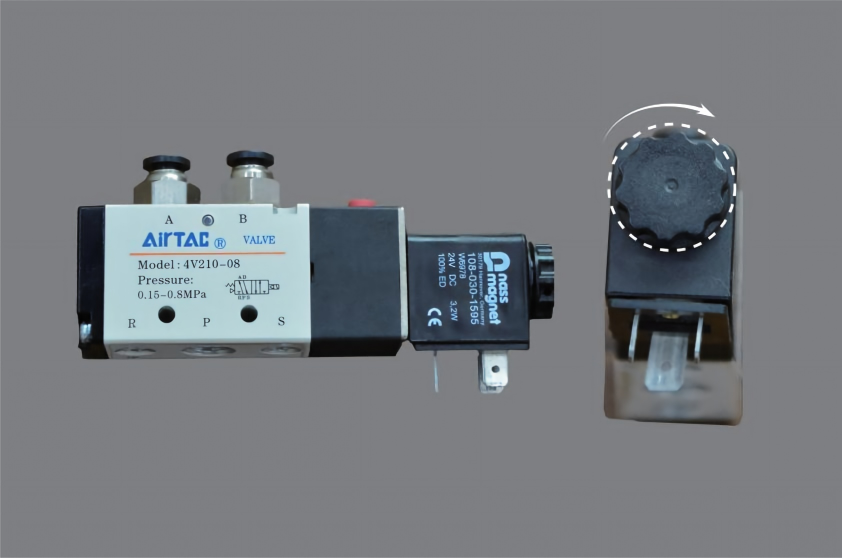
As the core actuator for automatic gas circuit switching of the whole unit, the 24V DC solenoid valve is switched on and off via 24V voltage signals sent by the PLC/controller. It shifts the valve spool through electromagnetic force to precisely regulate the flow direction, on-off state and pressure relief of compressed air, oxygen and nitrogen waste gas. This enables cyclic processes including adsorption, desorption, pressure equalization and backblowing of the two adsorption towers, generating high-purity oxygen continuously.
It should be noted that this is a pilot control configuration: the 24V solenoid valve does not carry high-pressure process oxygen or compressed air. Instead, it only supplies low-pressure control air to actuate the spool of the pneumatic angle seat valve, which is the actual component that opens and closes the main gas pipeline.
I. Core Functions of 24V Pilot Solenoid Valves
1. Signal Amplification & Remote Electric Control
The PLC only outputs weak 24V electrical signals, which cannot directly drive the cylinders of large-bore angle seat valves. When energized, the solenoid valve opens and delivers 0.4–0.6 MPa instrument air to the actuator cylinder of the angle seat valve, pushing the valve disc to open or close the main pipeline. Once power cuts off, the solenoid valve exhausts air, depressurizing the angle seat valve cylinder, and the valve automatically closes under spring return.
2. Timing Logic Switching (Core of PSA Oxygen Generation)
The equipment cyclically controls multiple 24V pilot valves according to programmed logic. These valves respectively drive pneumatic angle seat valves on pipelines for air intake, pressure equalization, pressure relief, oxygen output and cylinder filling, realizing automatic cyclic adsorption, desorption and pressure equalization of the dual towers.
- Pilot valve energized → angle seat valve opens, corresponding pipeline connected
- Pilot valve de-energized → cylinder exhausts air, angle seat valve forced closed
II. Complete Working Flow
Compressed instrument air → 24V solenoid valve (electric control switch) → Cylinder of pneumatic angle seat valve → Spool movement of angle seat valve → On-off of main process gas circuit
The solenoid valve only controls the on-off of control air and never comes into contact with high-pressure oxygen medium in the main pipeline.
III. Reasons for Adopting DC24V (Specially Designed for Oxygen Equipment)
1. Low-voltage direct current generates no electric arc sparks, delivering explosion-proof safety in oxygen-rich flammable environments;
2. Matches the standard output voltage of PLCs for oxygen generators with no extra conversion modules required;
3. Low voltage eliminates electric shock hazards during maintenance; the coils resist voltage fluctuations and maintain long-term stable operation.
IV. Typical Application Scenarios on Oxygen Generators
- Pilot control for pneumatic angle seat valves at adsorption tower air intake
- Pilot control for tower pressure relief & vent angle seat valves
- Angle seat valves on pressure equalization pipelines
- Finished oxygen output pipelines
V. Simple Fault Diagnosis Logic
1. 24V solenoid valve powered yet angle seat valve fails to actuate: clogged solenoid valve, insufficient control air pressure, blocked exhaust hole of the solenoid valve
2. Solenoid valve fails to shift and outputs no air: burnt coil, missing 24V power supply
3. Angle seat valve leaks due to incomplete closure: poor air exhaust of the pilot valve, failed return spring of the cylinder