
Choose Your Site
Global
Introduction
In fields such as medical care, high‑altitude oxygen supply, industrial smelting, and aquaculture, pressure swing adsorption (PSA) oxygen generation has become the mainstream on‑site oxygen supply solution due to its high efficiency, convenience, and low cost. As the “heart” of a PSA oxygen system, the zeolite molecular sieve directly determines oxygen purity, recovery rate, and overall energy consumption.
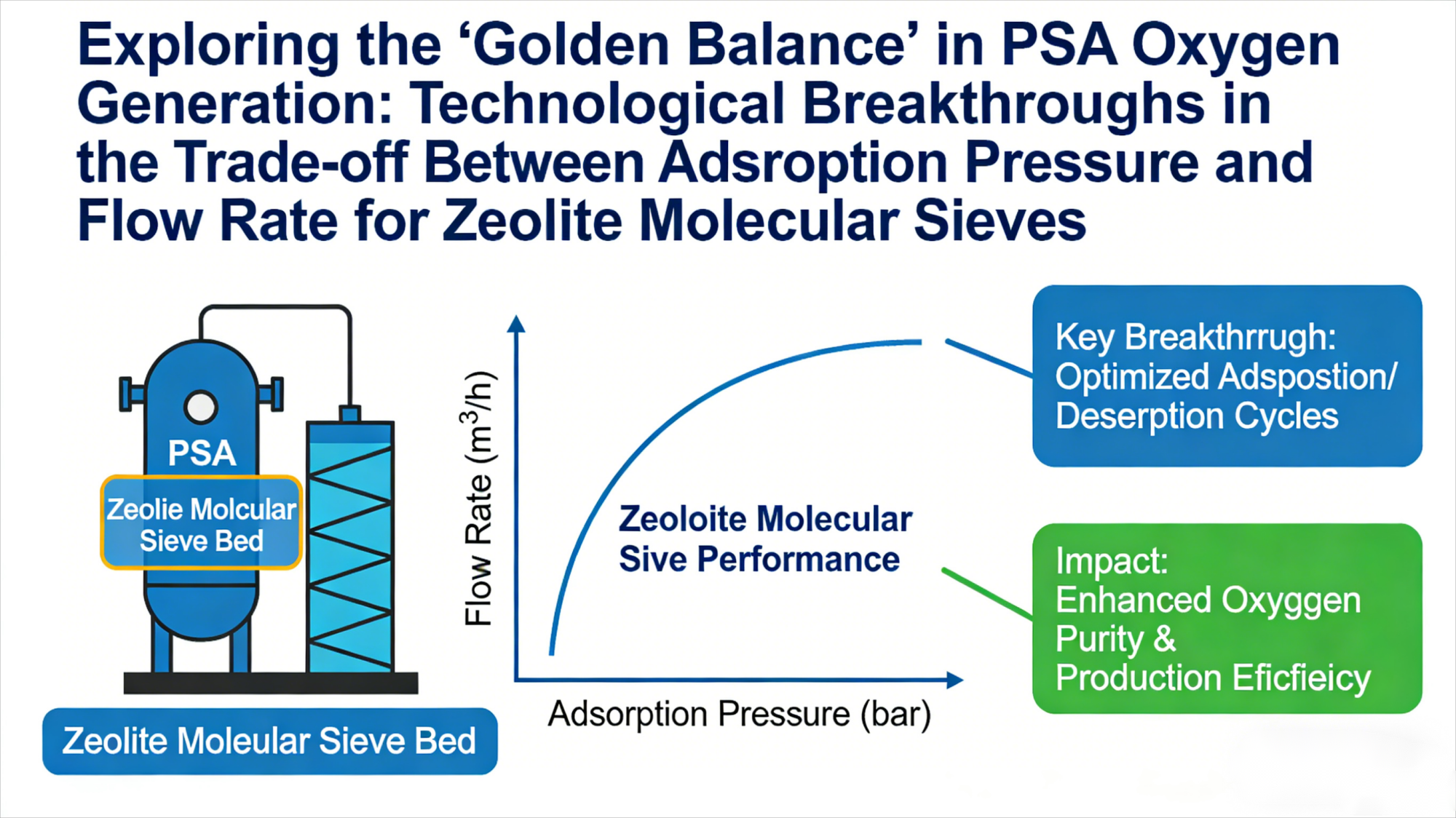
Among the numerous variables affecting molecular sieve performance, adsorption pressure and inlet/outlet flow rate are widely recognized as the two core parameters. Striking the optimal balance between them not only tests the limits of the molecular sieve material but also dictates the economy and stability of the oxygen generator. In this feature, we take a deep dive into this technical core.
In the PSA oxygen production process, zeolite molecular sieves use their unique crystal structure to preferentially adsorb nitrogen under high pressure, thereby enriching oxygen. Adsorption pressure is the fundamental driver of this physical separation process.
1. The “Capacity Dividend” of High Pressure
Increasing the adsorption pressure can significantly enhance the dynamic adsorption capacity of the molecular sieve (i.e., the amount of nitrogen adsorbed per unit mass of sieve under specific operating conditions). For oxygen generators with deep beds, appropriately raising the adsorption pressure (typically in the range of 0.4–0.8 MPa) reduces the required molecular sieve volume, allowing for a more compact equipment design.
2. The “Hidden Trap” of Pressure Fluctuations
However, higher pressure is not always better. Excessive adsorption pressure brings three major challenges:
Sharp increase in energy consumption: The energy consumption of the air compressor rises exponentially, contradicting the industry trend toward energy efficiency;
Structural damage: Frequent high‑pressure impacts can cause abrasion or even pulverization of the zeolite molecular sieve particles, shortening their service life;
Difficult desorption: If the pressure drop during equalization or depressurization is insufficient, nitrogen cannot be fully desorbed, leading to “poisoning” of the molecular sieve and a sharp drop in oxygen concentration.
Technology frontier: Leading molecular sieve manufacturers are focusing on developing low‑pressure‑drop, high‑efficiency sieves. By optimizing the silicon‑to‑aluminum ratio and pore structure, these sieves maintain a high nitrogen‑oxygen separation coefficient even under medium to low pressure (0.4–0.6 MPa), thereby reducing dependence on high‑pressure air compressors.
If pressure determines the feasibility of separation, flow rate determines the efficiency and cost‑effectiveness. Flow rate encompasses two aspects: the inlet velocity of the feed gas entering the adsorption tower and the production velocity of the product gas leaving it.
1. Excessive Flow Rate: The Risk of Breakthrough
When the inlet flow rate is too high, the residence time of the gas inside the adsorption tower shortens. Nitrogen molecules do not have enough time to diffuse into the micropores of the molecular sieve and are carried out by the gas stream, causing the mass transfer zone (MTZ) to become overly long. If the front of the MTZ breaks through the adsorption bed before the end of the adsorption cycle, oxygen purity drops sharply.
In addition, excessively high flow rates generate strong fluid scouring forces, increasing friction between molecular sieve particles. This leads to more fines, which can clog pneumatic valves and filters.
2. Excessive Low Flow Rate: Sacrificing Economy and Efficiency
Conversely, if the flow rate is too low, while purity can be guaranteed, the equipment’s production efficiency (output) drops significantly. To achieve the target oxygen output, manufacturers have to increase the diameter of the adsorption tower or add more molecular sieve, raising equipment cost and size.
Technology frontier: Modern high‑end PSA oxygen generators typically adopt either a “shallow bed + fast cycle” design or a “deep bed + optimized gas distribution” approach. Using computational fluid dynamics (CFD) simulations, the internal gas distributor of the adsorption tower is optimized to ensure that the gas stream passes through the molecular sieve bed in a “plug flow” pattern, avoiding channeling and local high‑velocity zones, thereby achieving the optimal balance between mass transfer resistance and adsorption efficiency.
Adsorption pressure and flow rate are not independent variables; their coupling determines the specific energy ratio (SER) of the equipment.
In practical engineering applications, we find a core pain point: traditional molecular sieves have limited adaptability to fluctuating operating conditions. When the equipment’s environment changes (e.g., high‑altitude low pressure) or the feed air compressor output fluctuates, the original pressure‑flow balance is disrupted, causing the oxygen generator to perform poorly.
Breakthrough directions for next‑generation highly adaptable zeolite molecular sieves:
High mechanical strength and abrasion resistance: To withstand high‑flow‑rate, high‑frequency PSA cycles, next‑generation sieves use improved binder formulations to achieve crush strength exceeding 30 N per particle, significantly reducing attrition and keeping the bed clean even under high‑pressure, high‑flow conditions.
High efficiency over a wide pressure range: Through advanced cation exchange techniques, these sieves maintain stable nitrogen adsorption capacity across a pressure range of 0.4–0.9 MPa. This means that even when the equipment switches between extreme modes (e.g., low pressure with high flow, or high pressure with low flow), it can still deliver stable oxygen purity of 90%–93%.
Fast mass transfer kinetics: Optimizing crystal size and mesopore distribution shortens the diffusion path for nitrogen molecules (optimized LDF model), allowing the equipment to use shorter cycle times (faster switching frequencies). This characteristic enables the equipment to withstand higher operating flow rates while maintaining purity, achieving “smaller tower, higher output.”
With the advancement of smart manufacturing and digital twin technology, PSA oxygen generator design is moving away from purely empirical methods.
In the future, technical discussions will no longer treat adsorption pressure and flow rate in isolation. Instead, sensors will monitor real‑time pressure profiles and temperature fields inside the tower, while AI algorithms will dynamically adjust valve timing and cycle times.
Conclusion
As the “chip” of PSA oxygen generation, the performance of zeolite molecular sieves depends on precise control of adsorption pressure and flow rate. Against the backdrop of carbon‑peak goals and the push for localization of high‑end medical equipment, only by deeply understanding the physicochemical principles among these three factors and continuously pushing the limits of molecular sieve materials can we produce truly efficient, long‑lasting, low‑energy‑consumption oxygen generators.
For equipment manufacturers, selecting a zeolite molecular sieve that combines high‑pressure adsorption capacity, efficient low‑pressure desorption, and robust resistance to high flow rates is key to building a core competitive advantage.