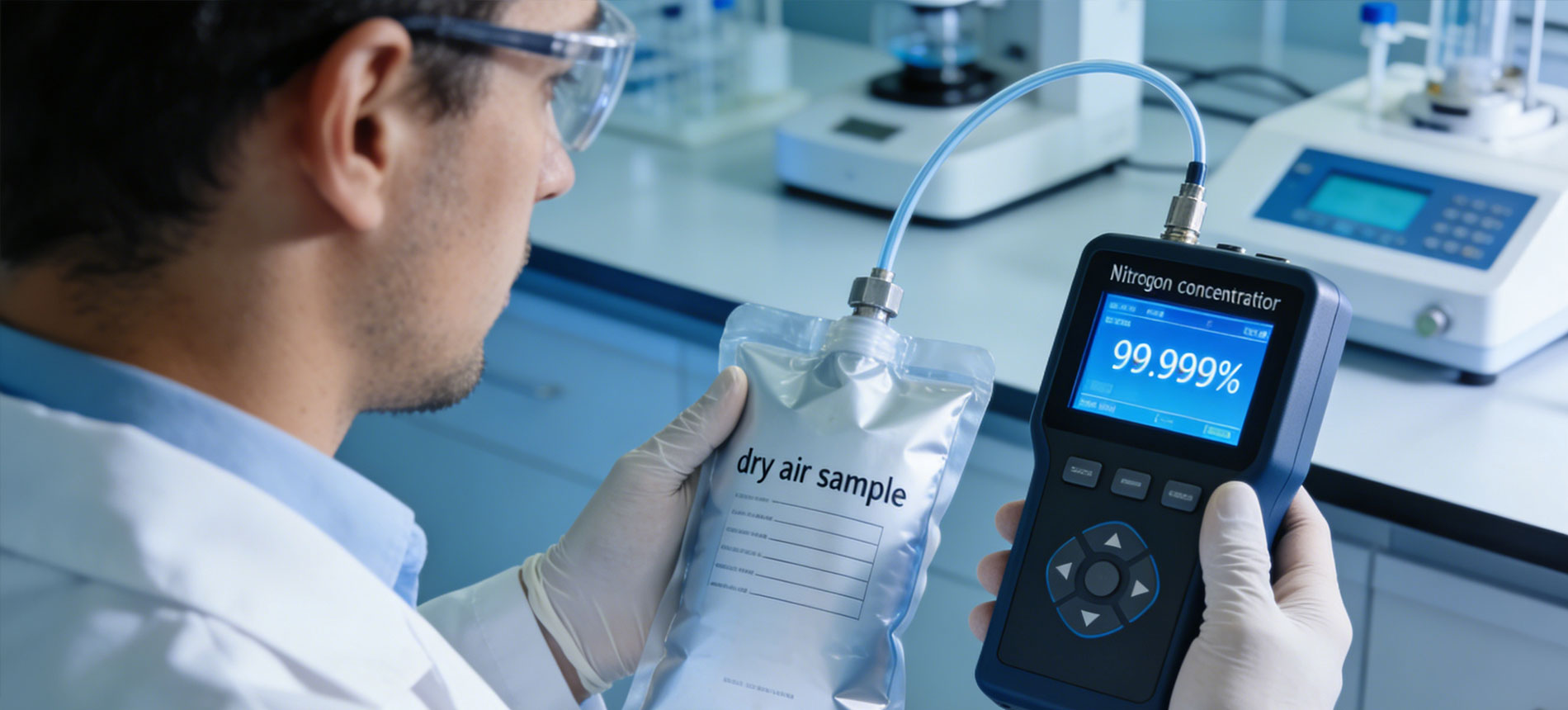
In the parameter labeling and industrial communication of PSA nitrogen generators, there is a professional convention: nitrogen purity is not marked directly by the nitrogen percentage, but defined by residual oxygen content. Many customers wonder why nitrogen equipment uses oxygen residue instead of direct nitrogen purity marking. This article explains the core reasons from working principle, detection technology and industry conventions.
1. Working Principle: Oxygen Is the Main Impurity in Air
Compressed air is the raw material for nitrogen production. Air consists of about 78% nitrogen, 21% oxygen, and only 1% trace gases including argon, carbon dioxide and water vapor.
PSA nitrogen generators separate air through carbon molecular sieves. Its core function is to remove oxygen and retain nitrogen.
In the whole process, oxygen is the highest-content, hardest-to-separate impurity that affects industrial production quality. Other trace inert gases are negligible due to their extremely low content.
Simply put, nitrogen purification from air is essentially an
oxygen removal process. The lower the oxygen content, the higher the nitrogen purity.
2. Detection Logic: Oxygen Testing Is More Accurate & Cost-Effective
Higher detection precisionFor high-purity nitrogen scenarios, nitrogen concentration is extremely high (e.g. 99.99%). Direct nitrogen detection leads to magnified errors due to tiny numerical changes.
Residual oxygen exists in trace amounts (e.g. 0.01%), and subtle variations can be easily captured by professional sensors. Oxygen analyzers feature high sensitivity, stable readings and accurate data.
Universal & affordable equipment configurationHigh-precision oxygen analyzers are standard, low-cost, easy to install and maintain in the industry. Professional high-precision nitrogen detectors are expensive and rarely used. Operators can quickly check nitrogen quality only by reading the oxygen meter.
3. Industry Standard: Global Universal Marking Convention
Simple conversion formulaIndustry unified formula:
Nitrogen Purity = 100% - Residual Oxygen ContentExample: 0.1% oxygen residue = 99.9% nitrogen purity; 0.01% oxygen residue = 99.99% nitrogen purity. Staff can judge the grade at a glance without complex calculation.
Fit actual industrial requirementsWelding, explosion protection, food preservation, chemical anti-oxidation and electronic packaging all require isolating oxygen oxidation and fire risks. Users focus on whether residual oxygen will damage products or cause safety hazards. Marking by oxygen content perfectly matches production acceptance standards.
Summary
Defining nitrogen purity through residual oxygen content is formed by air composition characteristics, detection advantages and industrial practical needs.