
Choose Your Site
Global
During the operation of PSA oxygen generators, moisture is an easily overlooked yet highly destructive factor. Whether for small household units or large industrial oxygen production equipment, moisture’s erosion of molecular sieves acts like a slow-acting poison: its effects are barely noticeable in the early stage, yet once problems surface, irreversible damage is often incurred. For users requiring 99.5% high-purity oxygen output, moisture control is a decisive factor determining stable performance.
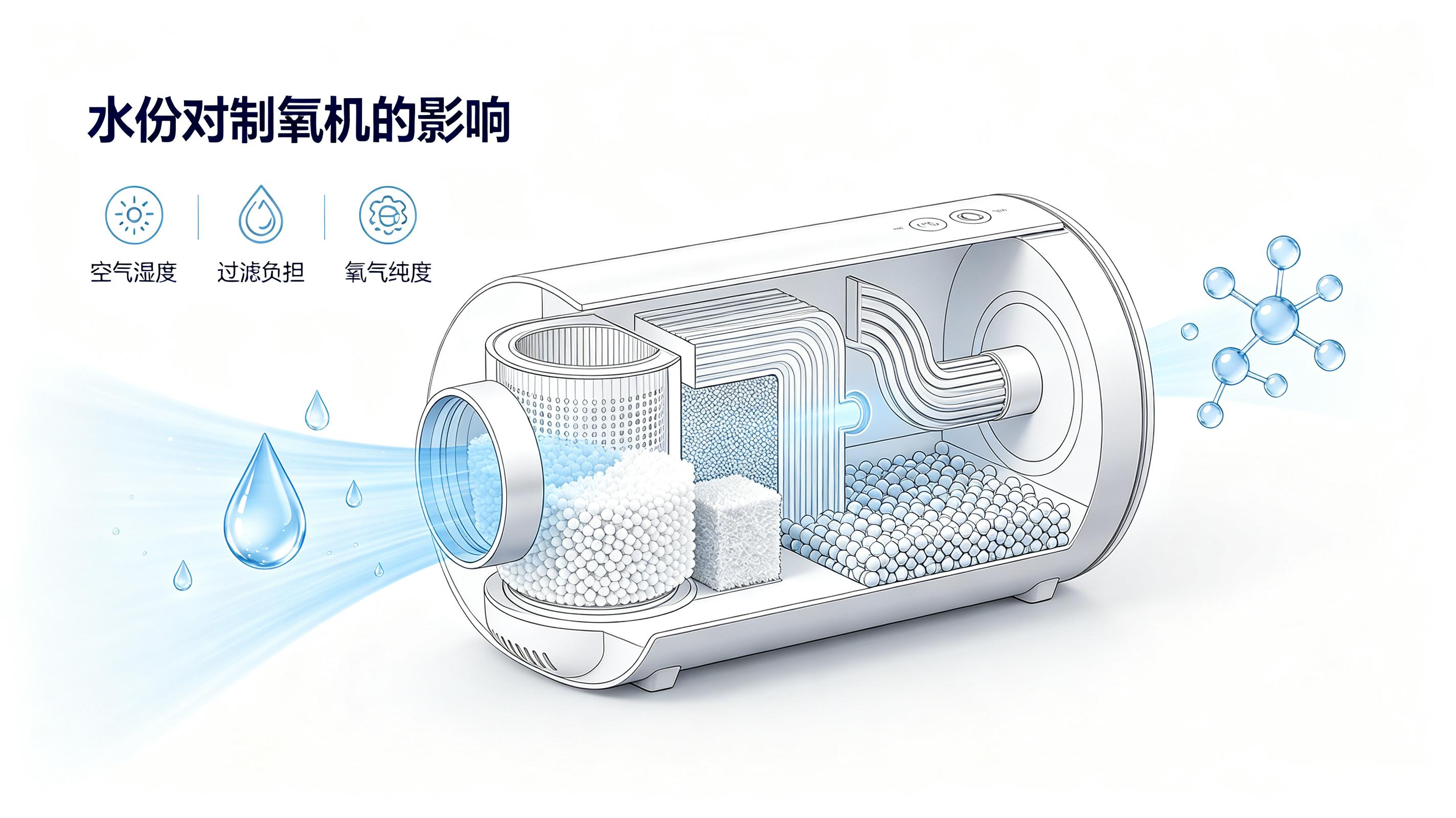
I. How Moisture Ruins Molecular Sieves
The core component of a PSA oxygen generator is the molecular sieve, a porous adsorbent material that separates oxygen and nitrogen via selective nitrogen adsorption. Mainstream commercial molecular sieves (such as lithium-type low silica-alumina X molecular sieves) have strong polar attraction to water molecules, and water vapor contained in feed gas directly impairs the adsorption capacity of molecular sieves.
Moisture damages molecular sieves on three key levels:
Micropore Blockage & Sharp Drop in Adsorption Capacity
Water molecules will preemptively occupy the active micropore sites of molecular sieves and block channels for nitrogen adsorption. Under normal conditions, molecular sieves efficiently separate oxygen from nitrogen; once moisture invades, adsorption efficiency plummets sharply. Test data shows that oxygen purity of damp molecular sieves may drop from 95% to below 80%.
Molecular Sieve Pulverization & Greatly Shortened Service Life
Apart from blocking pores, moisture reduces the structural strength of molecular sieves. Subject to alternating pressure cycles inside the adsorption towers of PSA units, damp molecular sieves quickly pulverize. Relevant research confirms that water vapor triggers sieve pulverization and drastically cuts its service lifespan.
Irreversible Sieve Poisoning
Damage caused by moisture to molecular sieves is usually permanent. Water molecules trapped inside sieves cannot be fully removed through standard desorption processes. Long-term damp exposure leads to irreversible performance degradation, caking and pulverization of molecular sieves. Once molecular sieves suffer moisture poisoning, full replacement becomes the only viable solution.
II. Direct Impact of Moisture on Oxygen Purity
The urgency of moisture control is especially prominent for users demanding high-purity oxygen.
Standard PSA oxygen generators typically produce oxygen with purity ranging from 90% to 95%. However, damp molecular sieves can send oxygen purity crashing from above 95% down to less than 80%. Scenarios requiring 99.5% ultra-high-purity oxygen—including medical applications, electronics manufacturing, precision metal cutting and other high-end industrial sectors—cannot tolerate any purity decline, as this will result in defective finished products, failed production processes and even potential safety hazards.
Laboratory tests have proven that rising feed gas humidity continuously lowers oxygen concentration of product gas. The presence of water molecules severely hinders molecular sieves’ ability to adsorb nitrogen. Simply put: excess moisture equals compromised oxygen purity.
III. Standard Moisture Control Specifications for Industrial Oxygen Generators
Industrial oxygen generators adopt strict quantitative standards for moisture management.
Dew point serves as the core evaluation index: the lower the dew point value, the less moisture the gas contains. General intake air requirements for PSA oxygen generators specify an atmospheric dew point of ≤ -40°C. High-end premium equipment enforces stricter standards, with product oxygen dew point (at atmospheric pressure) controlled between -40°C and -70°C.
The air pretreatment system of industrial oxygen generators normally adopts multi-stage purification workflows: compressed air first passes through high-efficiency oil removers to eliminate most oil and water contaminants, then flows through refrigerated air dryers to lower dew point to 2–10°C. Processes requiring superior drying performance will additionally install adsorption dryers or combined drying units to further reduce dew point.
If air dew point fails to meet the -40°C threshold, condensed water will separate out from product gas. In summer, accumulated water inside equipment halts normal operation; in winter, residual moisture freezes and clogs pipelines. Unregulated dew point issues may trigger production shutdowns at minimum, and complete equipment scrapping in severe cases.
IV. Sources of Moisture & Corresponding Preventive Measures
Moisture enters PSA oxygen generators via three primary routes:
Natural Water Vapor in Feed Air
Ambient air inherently contains water vapor. Humidity content of intake air surges in hot, humid regions or summer seasons, and this water vapor flows into the whole system along with compressed air.
Condensate Generated During Air Compression
After air is pressurized by compressors, internal water vapor condenses into liquid water. Inadequate pretreatment systems allow this liquid water to directly infiltrate the molecular sieve bed.
Wet Air Drawn In Through System Leakages
Negative pressure forms inside adsorption towers during the desorption cycle. Poor sealing at tower flanges or valve joints may draw surrounding humid air into the equipment. Persistent air leakage leads to molecular sieve failure from sustained humid air adsorption.
Effective moisture prevention solutions are listed below:
Front-end Pretreatment: Before compressed air enters the main oxygen generator unit, complete water removal, oil separation and dust filtration procedures are mandatory. Refrigerated or adsorption dryers are widely used for deep dehumidification.
Air Buffer Tanks: Air storage tanks stabilize pressure fluctuations and prevent incompletely treated compressed air carrying liquid moisture from rushing directly into the oxygen generator.
Regular Equipment Sealing Inspection: Routinely check sealing performance of adsorption tower flanges, valve connections and pneumatic valve shaft seals.
Operating Environment Regulation: Avoid long-term operation under high-temperature and high-humidity conditions; install equipment in dry, well-ventilated spaces.
V. Conclusion
Moisture ranks among the most common and fatal hazards affecting PSA oxygen generator operation. It silently clogs molecular sieve micropores, reduces adsorption efficiency, shortens equipment service life, and ultimately leads to substandard oxygen purity. For operators of industrial oxygen generators and 99.5% high-purity oxygen equipment, constructing a complete air pretreatment system, rigorously maintaining intake dew point standards and conducting regular sealing inspections are fundamental guarantees for stable long-term equipment operation and consistent qualified high-purity oxygen output.
Bear this rule in mind: Controlling moisture protects molecular sieves; protecting molecular sieves preserves oxygen purity.